Category Archives: Knitting

Turning a corner, so to speak

1

A little while ago I started thinking about a pair of socks I wanted to knit. This isn’t that unusual, except that it wasn’t a pair I’d seen out there before. I poked around on Ravelry and didn’t see the socks I wanted, so I decided to hunker down and do the math and figure them out myself. Admittedly, they weren’t too tricky or fancy, and that was kind of the appeal. After colourwork and lacework, what I really wanted was a sock that was easy to knit, but not boring. I knew exactly what yarn I wanted to use (I’d spotted it on my shopping spree), so when I saw it again I snapped it up and set about charting.

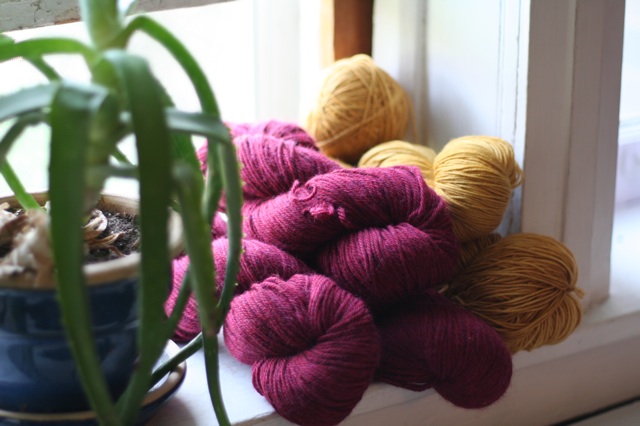
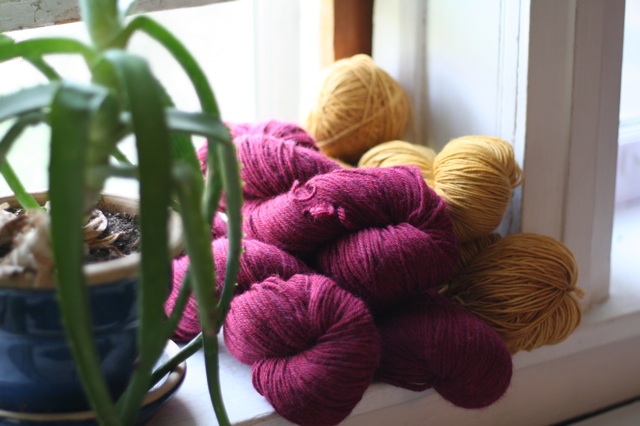
Malabrigo sock in colourway Boticelli Red – it's an incredibly deep and decadent colour.

I cast on last week, and I’m pretty pleased with how things are progressing.

This is actually my first cable project (so it still qualifies as a socks-as-learning-tool project), which added a little bit more daring to the design. I’m also knitting at a really tight gauge (about 11 stitches to an inch), which I’m hoping will make for a long-wearing sock.

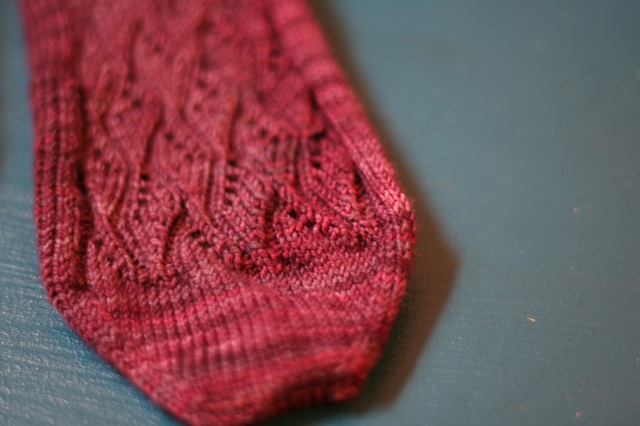
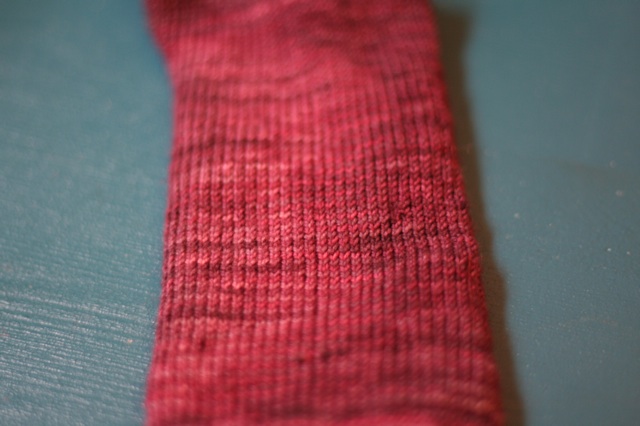
What really pleases me about this project, though, is that for the first time, my ssks look just like my k2togs. Seriously. Maybe you don’t have this problem, but for me, my decreases rarely match. They’re close, absolutely, but they just aren’t quite equal. It always seemed that no matter what I did, my ssk had a floppy arm. There, I said it. It was imperfectly formed, and although I’m sure no one else noticed, I noticed, and I bugged me.  It turns out, though, that there’s a solution: Cat Bordhi devised a way to make “slim and trim ssks” (YouTube link) and you know what? It totally works. I will never ssk without a “hungry stitch” again if I can help it. Just look at this:
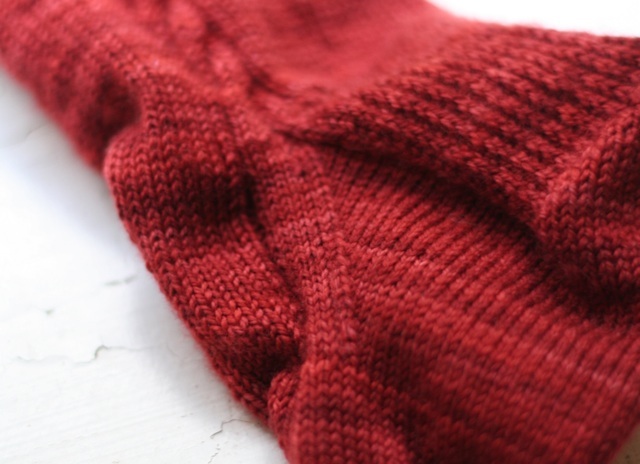
ssk

k2tog

I thought the cables would be my favourite part of the socks, but you know, I think the ssks are jockeying their way forward. They’re so tidy. They’re so trim. They’re so indistinguishable from their k2tog brethren. I’m excited to get to the toes where their matchy-ness will really be on display. This is an incredibly nerdy thing to be excited about, but I just found out that, after months of thinking ‘there has to be a better way,’ it turns out there is. I am thrilled!

Weekend socks

3

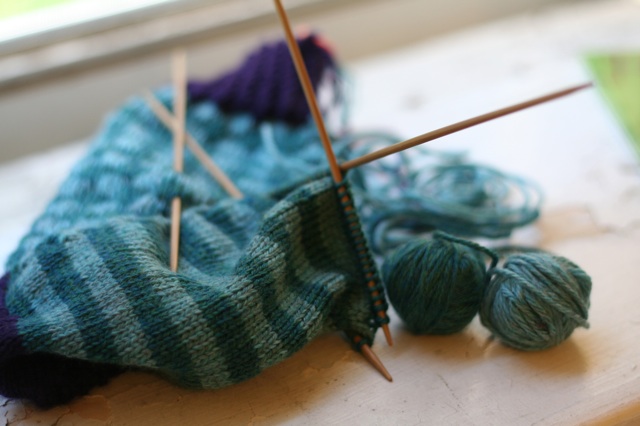
As I mentioned, I finished the Happy-Go-Lucky boot socks on the weekend and I am mostly pleased with them. I was a little worried I wouldn’t have enough wool to get them done, though, because halfway through the second foot, I was looking at this weeny little balls and wishing very much that I had a scale at home. I managed to squeak them out, though, and have barely enough of either of the stripy colours to fill a thimble.

Worried. So worried I took a photo.

I have some quibbles with the way the pattern is written, but first, pictures!

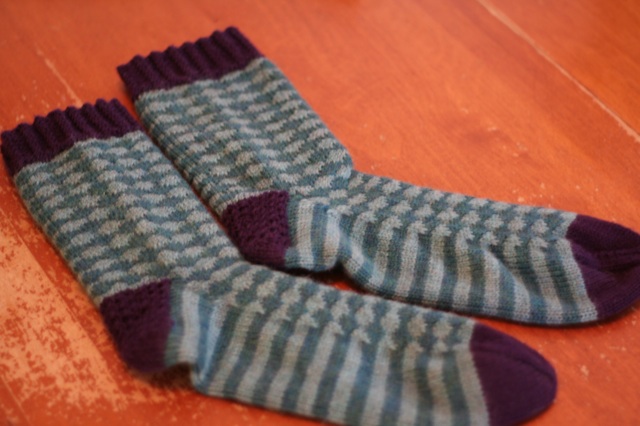
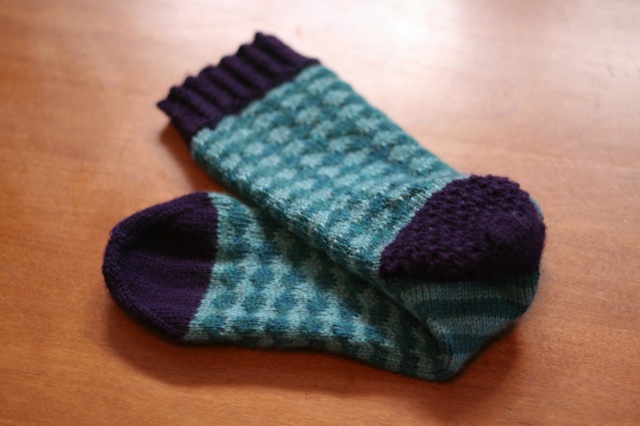
Count 'em: two finished socks!

L and I are both going to work on our sock photography/modeling for next time.

Okay, now that that’s out of the way, here are the details:
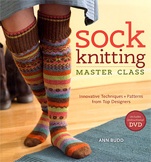
Pattern: Happy-Go-Lucky boot socks by Véronik Avery, from Sock Knitting Master Class
Yarn: Cascade 220 Superwash Sport in colourways 1910 (blue), 859 (teal), and 803 (purple)
Needles: 2.75 mm Clover bamboo dpns

Blocking really helped. You can see how smooth the blocked sock on the left is, compared to the unblocked and bumpy one on the right.

In terms of modifications, I did a few things this time and have others planned for next time around. First, though, let me explain something fundamental: This pattern is only written for an 8.5-inch foot. My foot is 9-inches around. I knit this anyway. I increased the gauge slightly, and, mathematically, that should have done it. However, these socks are quite, erm, fitted, and as I said previously, I was actually worried I wouldn’t be able to get my foot all the way in. Clearly, I can, but it’s a strain, and it pulls the stitches, and the colourwork doesn’t look as pretty as it ought to. So, that’s the background, here are the modifications:

Actual mods: Besides changing the gauge, I also added an extra pattern repeat to the leg because I wanted it to be a little higher, and when decreasing the gusset I only went down to 34 heel stitches (instead of 30) because I don’t think my foot width is really that much narrower than my ankle/leg width.

Future mods: This is a little tricky, because I’m just not sure what to do about the heel area. In theory, I want to add an extra six stitches (one diamond) to the pattern, which would give me a little more space. But, that either means creating a bottleneck in the ankle again, or having a foot that’s 72 stitches around, which is too many (baggy-footed socks are not appealing). I think, what would be best, is this: Rather than decreasing six stitches at the ankle, simply divide the stitches so there are 36 on the heel flap and 30 on the instep; work an extra repeat of the heel pattern (although I’d be tempted to just work a regular slip-stitch heel) and deal with the extra stitches in the gusset decreases (I would decrease to 34 again, I think, because the foot fit well). Most of my problems with the sizing came as a result of the ankle/heel, so that’s where I would centre my changes.

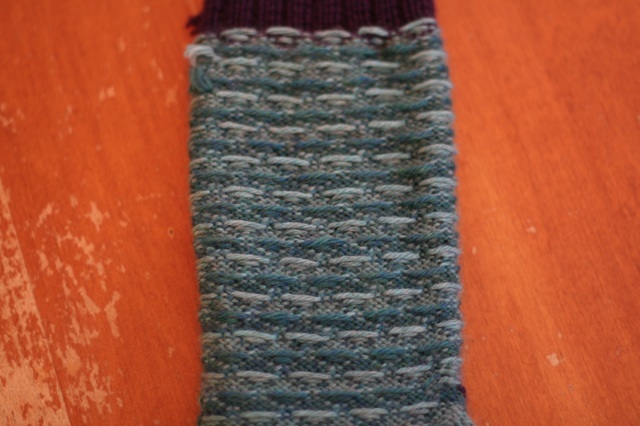
All of this being said, if you like the look of these socks/this pattern, don’t be scared off. It was a wonderful mix of easy and interesting, and if you’ve never tried slip-stitch colourwork, it’s a great primer. It’s actually a good lesson for stranded colourwork in general, because it allows you to get used to the idea of maintaining floats while only having to manage one colour per row. Here’s the wrong-side of the work, where you can see the floats that run behind the slipped stitches.

I think the pattern on the inside is kind of pretty, actually.

All in all, it’s a good pattern and I’m sure I’ll knit it again (truly, the colour combinations are endless!). I’ve ravelled it here, if you’re into that sort of thing.

Ribbing Forever

0

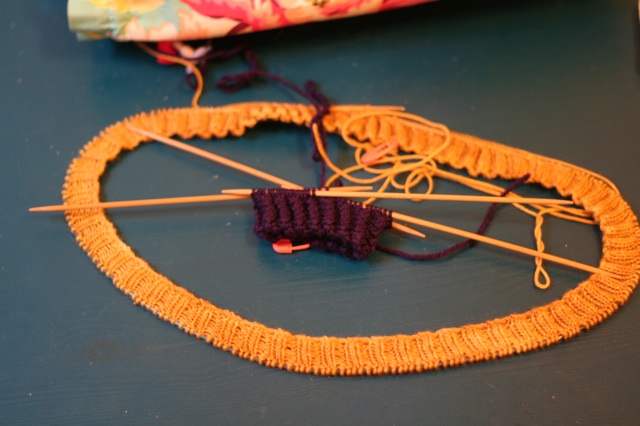
As promised, I cast on for both the sweater and my second sock this week. I thought it would be nice – you know, give my knitting a little perspective to have a big project and a (relatively) little one. But then I realized that I’d miscalculated. I should have cast on one, worked for a while, and then cast on the other. Because right now, I’m in a neverending loop of ribbing.

At least they're complimentary colours? I don't know why the lighting is so yellow, though. In real life, the sweater is much softer than this.

I suspect every knitter has their thing that they hate, but for me, it’s ribbing. I know it’s important. I know it will look nice when it’s done. I don’t care. Ribbing, for me, is slow. It isn’t interesting slow, though, like following a lace chart or something, it’s requires just enough attention to allow me to properly do anything else, and it goes on and on and on.

The only bonus to all this ribbing is that, compared to the sweater, the sock is flying (it’s also ribbing with mini cables, so it isn’t quite so annoying, but still). I still have half and inch on the sweater’s ribbing and, well, I really can’t wait to get there. I briefly contemplated not finishing the ribbing – just stopping at an inch and calling it a day – but I knew I would regret it when all was said and done. So I rib on (and on and on and on), and when the day comes that I get to pass through the glorious gates of stockinette and just knit mindlessly while listening to something, or watching something, or maybe even reading something, then I’ll be glad that I toughed it out.

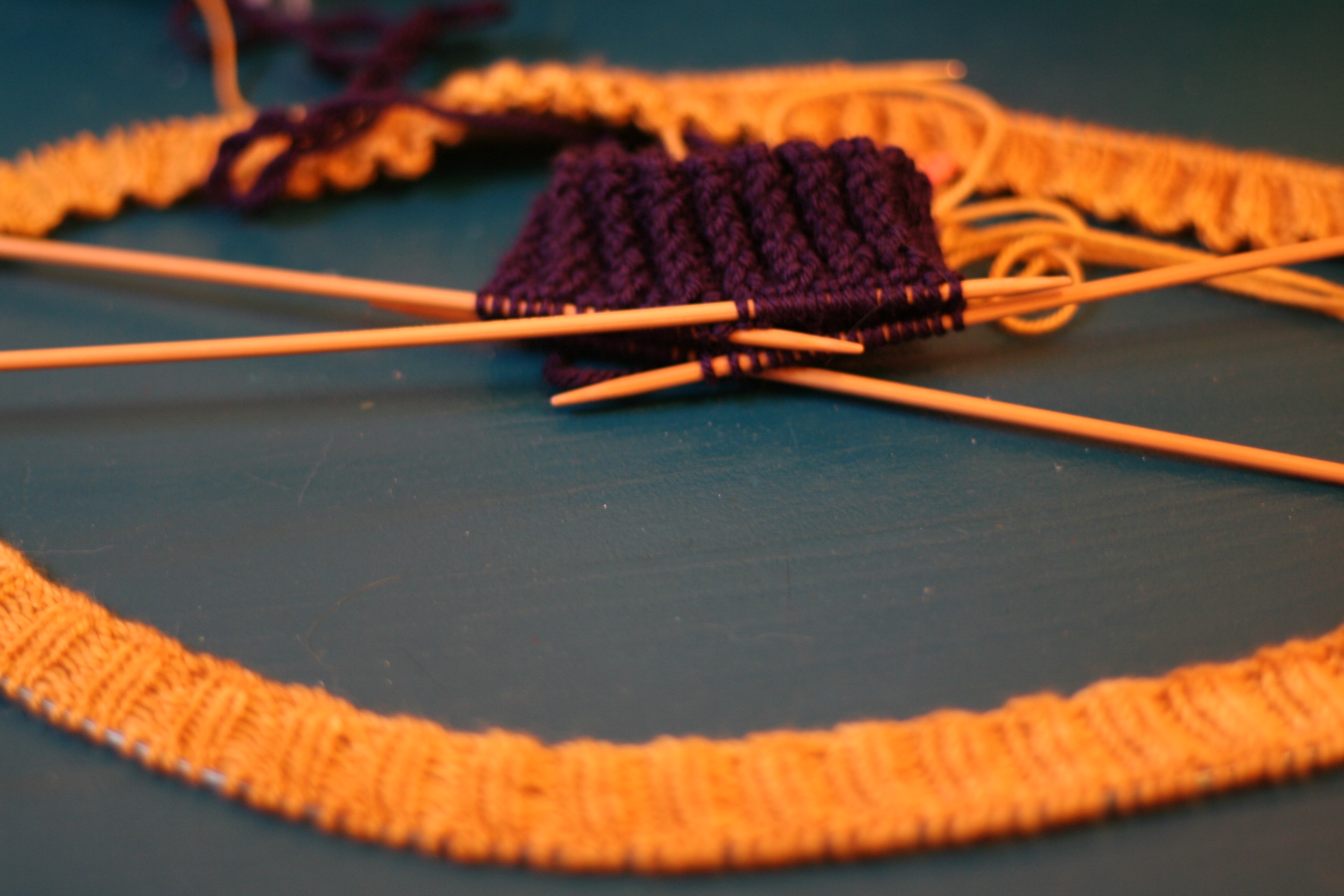
Mini cables are still ribbing.

A Cautionary Tale

8
Yarn splurge

Last weekend I went into Lettuce Knit to exchange some wool (I had an extra, unwound skein of the wool I used for Almondine, so I thought I’d plan ahead and get something for the next pair of socks). I had just started the Happy-Go-Lucky socks, and thought I’d ask Natalie what she thought – I’m still new to colourwork and wanted to make sure I was doing things properly. For the record, this is how far along I was:

Happy-Go-Lucky

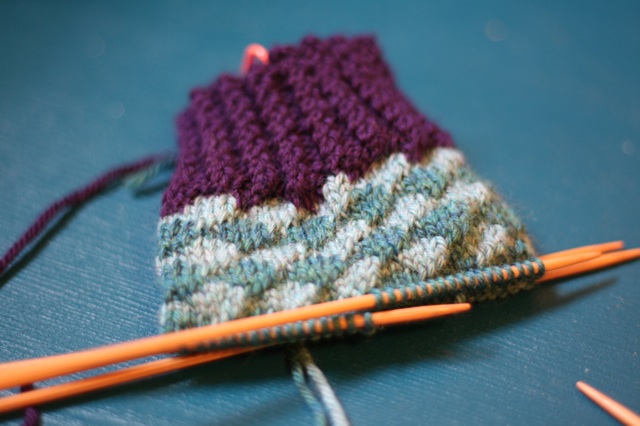
Just a bit of top.

At that point, I could get my foot through without any trouble. Nonetheless, Natalie took one look at them and said “be careful.” Her warning: She has highly-arched feet and there are some socks she just can’t get her foot into. I thought about that for a minute and then decided to just got for it. I was knitting above gauge, I thought, surely that will save me. Still, her warning haunted me all week, and when I Friday rolled around and I was halfway through the foot I thought I should check. The heel did seem small to me, and I was (secretly) a little worried. I couldn’t get my foot through. It was because the socks were still on the needles I reasoned, and plowed on.

Still, I was worried. I went to work that night and then spent all my downtime on Ravelry looking at projects I could start on the weekend in case these socks decided not to fit. I need to do this. I need to plan for the worst so that if it doesn’t happen, I can rejoice, and if it does I have something else planned already so no worries. I picked two patterns (this one and this one) and decided that I’d finish the Happy-Go-Lucky toe on Saturday morning and then go buy the necessary wool for the other patterns. No big deal.

Of course, then the sock fit. Only barely, to be fair, but I got it on and it was comfortable and lovely. Perfect, right? Well, yes and no. You see, in all my planning for ways to not be horribly disappointed in case they didn’t fit, I got kind of excited about these other projects.

Happy-Go-Lucky

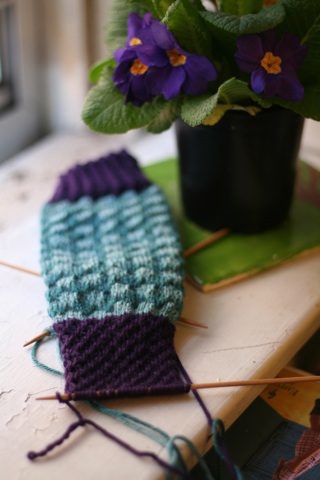
Half of a pair. Secretly, I'm pretty pleased about how this looks – especially the surprise stripes on the sole.

That meant I went to the yarn store anyway.

Yarn splurge

Three skeins each of Cascade 220 Heathers in colourway 4008 (for the scarf) and three of Malabrigo sock in colourway Ochre (for the sweater).

I have been swatching ever since. I will cast on the second sock this week, but I might also cast on a sweater. Maybe today. Maybe right now. You see what happens when you preplan for disaster?

Happy Go Lucky

2
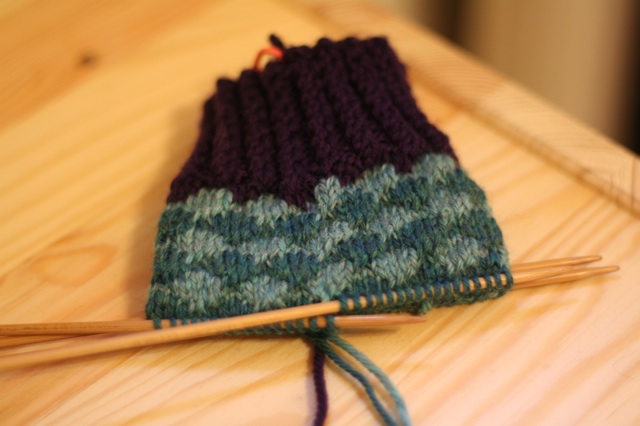
Happy Go Lucky, fresh out of the gate.

Wherever you are, I hope your weekend weather was a beautiful as the weather we enjoyed in Toronto. It’s March, remember, and it should be miserable, torturous weather throwing rain and slush and days no warmer than 5C at us; instead, though, we’ve been enjoying days of 15C, 16C, and 21C days! Deep down I know that this cannot last, and snow will likely fall once again before we’re fully free of winter, but right now I don’t care. This weather is incredible!

So, how do you knit in weather this delightful? My answer last year was not to. This year, my answer is take small projects outdoors. Thus, despite having just cast off one pair of socks, I cast on another. Meet the Happy-Go-Lucky boot socks from Sock Knitting Master Class, my current project go-to.

Happy Go Lucky, fresh out of the gate.

Happy Go Lucky, fresh out of the gate.

I’m knitting these in Cascade 220 Superwash Sport in 1910 (blue), 859 (teal), and 803 (purple). I am loving this wool. It is soft and buttery and it seems that 2.75mm needles are the perfect size because, in my hands anyway, the stitches feel almost like they’re forming themselves. I short, I am loving this project.

Anyway, because the weather was so gorgeous, and because I got the entire weekend off, L and I spent pretty much the entire weekend running all over the place and being outdoors. Except, the running (at least on Saturday) was actually bicycling. Oh heaven.

Old vs. new

Old and hard vs. new cushy and new.

This is my new old bike, and on Saturday morning L put a new cork wrap on my handlebars and then we took off all over the city. In no particular order: We went to Lettuce Knit so I could exchange some wool, to the Ex to throw a frisbee, we watched planes land on the Island, we went for fancy sandwiches, we went to one of our new favourite coffee shops – in short, we did all kinds of things we’d been talking about doing for ages and finally did because it was such a gorgeous day.

I took many pictures of this plane coming in to land, but this one looks the most like an action shot. (It was much sunnier that day than this photo would have you believe.)

In theory, this meant I didn’t have much time for knitting, but in practice, it all worked out fine (small projects, you see, are very portable). So, on Friday before work I spend three and a half hours knitting on a café patio with Zoe. Then, to cap on Saturday’s bicycling, Wendy and I met up for beer and sat knitting quite happily in a pub – much to the apparent amusement/confusion of a woman sitting at the bar, who turned around to stare at us for a quite some time. It was St. Patrick’s Day, though, so maybe she as just confused  as to why neither of us were knitting in green. Who knows.

Cafe knitting.

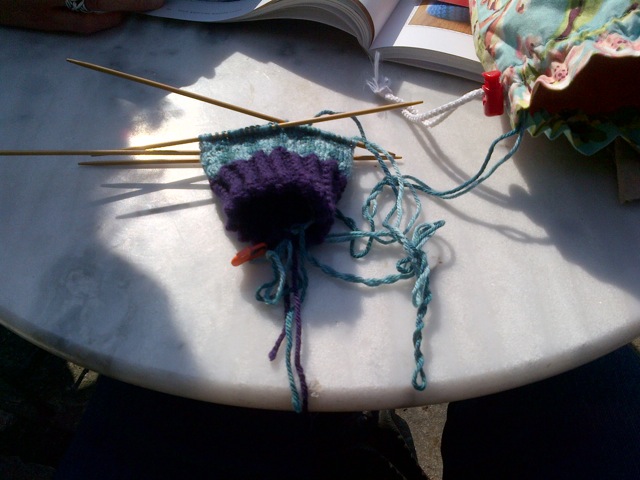
Cafe knitting, crappy cellphone photo.

What I do know though, is that if this weather keeps up, knitting through the summer will be an absolute pleasure because it will involve bicycling, coffee, beer, and lots of time out of doors with people I love.

Heel flap

Despite the busy weekend I still managed to get the heel flap finished (and now turned).

Lacy Socks: Almondine is finished!
6

Can you tell I’m excited? I have been knitting these socks for nearly a month, which seems like a crazy long time for a pair of socks, but I am nonetheless pleased with the results. (I should perhaps add that I have not owned “lacy socks” since I was a very little girl, at which time their wearing was restricted to when I was also wearing a “party dress.” This history makes these socks feel very everyday fancy and fun.)

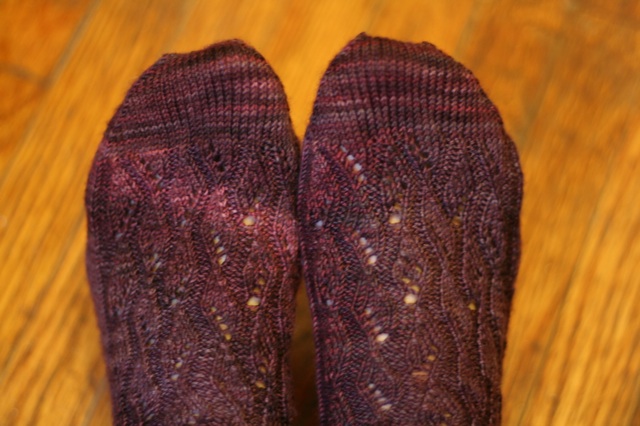
Almondine!

Almondine!

These strike me as the perfect kind of socks for Spring because the lace means they’ll breathe well and the merino wool they’re made from means they’re actually still quite warm. Also, as the weather gets warmer (it’s 16C in Toronto today!) I will return to wearing skirts and dresses and thus be able to show off my fancy work.

Right side, wrong side.

Right side, wrong side.

The pattern is, as you can see from the title of this post, called Almondine, and it’s from the book Sock Knitting Master Class by Ann Budd (the pattern is designed by Anne Hanson) – once I’ve knit a few more projects, I’ll write a little review of this book, but so far I quite like it. When I bought this book back in January, it was for two main reasons. First, I pretty much always have cold feet, so knitting socks seemed like an obvious way to keep myself busy and productive; after knitting a few pairs of basic socks, though, I decided I needed to spice things up, hence a book of patterns. Secondly, I wanted to expand my repertoire of knitting techniques, and it seemed to me that the repetitive nature of sock knitting would be a good place to do so. Thus, I have been making an effort to try new things. For example: I learned how to do the long-tail cast-on for these socks, which were also my first lace-work project. I also forced myself to concentrate on Kitchener stitch, which I had tried before but never felt very confident about.

Anyway, here are all the details:
Pattern: Almondine by Anne Henderson
Wool: Indigodragonfly Merino sock in colourway My Boyfriend had a Bicentennial (Buffy) – this colourway has almost a dozen gorgeous, subtle variations of purples and reds and pinks (my favourite of which was the cranberry-tinted mid tone) and I loved working with it. It isn’t a soft yarn, but it is smooth and even and perfect for socks.
Needles: Clover bamboo dpn in 2.75 mm

My Boyfriend Had a Bicentennial (Buffy)

My Boyfriend Had a Bicentennial (Buffy)

Modifications is getting its own line, because it includes things I learned about my own knitting strengths and weakness, as least insofar as they relate to knitting lace.
First, I suppose, it that once I figured out the logic of lace (the relationship between where a stitch is added to where one is decreased), the pattern became simple enough that I could put away the chart.
Second, that swatches are really important when you’re doing anything new. Maybe this should be point one, but whatever. I swatched this with 30 stitches on toothpick-thin 2.25 mm needles (as recommended) and ended up with a little tube that fit snugly around my thumb. Clearly, this was much too small, so I went up a needle size and delightfully found myself exactly on gauge. Imagine if I hadn’t swatched!
Third, when it comes to moving between needles, some connections are better than others. Knit to knit, fine. Purl to purl, fine. Purl to knit, fine. Knit to purl, loose and ugly. Because of this, I ended up with ladders along the “seam” of needles one and two all the way up the foot of my socks. In this pattern, it’s actually not noticeable when I wear them, but I know it’s there and I am annoyed. I have ravelled my solution to this.
Fourth, lace is really impressive. I knit these socks at home, on airplanes, in a bar, and at home, and everyone who saw them (knitters and non-knitters alike) thought them quite fancy. As a knitter, this is very satisfying and makes me want to knit nothing by lace in public (lesson: I am a little vain).

I will now, I suppose, learn lesson number 5, which is about blocking (something else I’ve never done). More on that once it has been (I hope) successfully accomplished.

Seen Knitting

1

I love seeing people knit in public, especially on transit. I have been known to knit in bars and cafés, but I generally use my transit time for reading because I’m almost never able to get a seat. (That being said, I once brought my knitting with me because I knew I’d finish my book and found I loved knitting on the subway.)

(This is not me)

(This is not me)

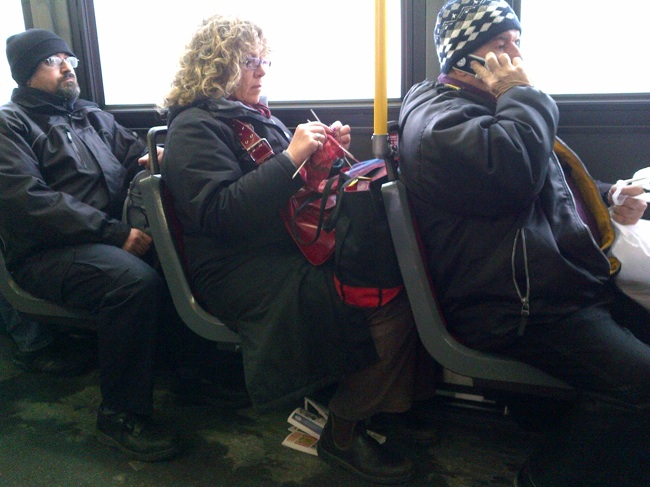
Anyhow. The other day I was on a bus and and this woman (above) was knitting a lovely pink sock across the aisle from me, so I sneakily took her photo (do you know her?). I realized, while I was watching her, that I rarely get to just sit and observe someone else knitting – it’s kind of mesmerizing. L watches me knit all the time (even if we’re supposed to be watching a movie or something), but he’s an engineer, so perhaps he’s interested in it as a method of construction or something. Naively, I assumed that watching someone knit would be most interesting if you weren’t a knitter; how wrong I was.

For example, this woman was knitting in the continental style (that is, throwing the yarn with her left hand). This looked like magic to me, an English knitter, and I found myself unable to tear my eyes away as I tried to figure out just how it all worked. She made it all look so easy, but when I tried it at home later on, I found my own hands were too clumsy to make it work. Nonetheless, seeing someone at work on her own project inspired me to try something new, and I wonder if it has this affect on others – non-knitters included.

This thought makes me want to knit in public more often. I very much like the idea of taking a craft/skill that is often so identified with the private and domestic and bringing it out into the public. I get a lot of stares when I bring my knitting to the bar where L and his friends are watching soccer, but I am constantly surprised and pleased to find they are looks of curiosity, not disapproval. So, as the weather improves, I think I will make more of an effort to get outdoors with my knitting – because why not, right?

What do you think of this? Do you watch public knitters? Are you a public knitter who feels watched?

(Also, I would like to point out that I’m not the only one taking secret pictures of public knitters. My friend Gustavo tweeted this photo the other day – don’t you wish you could ask her what she’s making and for whom? It looks so lovely and soft!)

Fake Spring Scarf

0

Remember this scarf?

An outtake from our previous photo shoot.

An outtake from our previous photo shoot.

Well, it seems like the end of February is the perfect time to write it up. Technically, I suppose, I knit this up at the beginning of January, when I decided I needed a better wool scarf (the first two I knit – back when I was just learning to knit – were both cowls, the first way too long and the second too short to wrap twice but two long to just wrap once). Anyway, I decided I wanted to start the New Year by knitting something easy, but still pretty.

I have accumulated a lot of Cascade Eco+ (it is gorgeous to knit with) so I picked three colours and set to work thinking about how best to knit them up.

Main colour – in real life, it's much more green.

Main colour – in real life, it's much more green.

Contrasting colour 1

Contrasting colour 1.

Contrasting colour 2

Contrasting colour 2.

I wanted something quick, so colour work was out, but I also wanted the scarf to have a main colour (and some symmetry), so any stripes would need to be fairly far apart, but not so far that the scarf with hang out the bottom of my coat (I hate that). And thus, the Fake Spring Scarf was born.

Right side – showing off the reversed middle stripes.

Right side – showing off the reversed middle stripes.

Comparing the right side to the wrong side.

Comparing the right side to the wrong side.

I’m not always the biggest fan of straight-up garter stitch and  I worried a lot that the colours would be too garish to wear with my bright red winter coat. Luckily, I ignored my initial misgivings, because this scarf is both warm and soft, and has garnered me many a compliment. I actually quite like that this looks”homemade” because, of course, it is. There’s something a little rustic about it, and although the wool is both thick and a little hairy, it is surprisingly soft around your neck while still feeling sturdy.

I kind of like knitting that has a right and a wrong side (it looks cleaner somehow), so I made sure to start all my stripes on the same side. That also means all the weaving is in the same area, which makes things a little tidier.

So stripy.

So stripy.

Fake Spring Scarf – so named because a) It’s in bright, springtimey colours, and b) It’s a nice quick knit, so when you’re hit with March snow you’ll have time to knit it up before it all blows out for the season.
Pattern: by me!
Needles: 6 mm
Yarn: Cascade Eco+ in colourways 2452 (green), 9454 (purple), and 9451 (blue-green)
Finished length: 61 inches
Gauge: 14 sts/24 rows = 3 inches in garter stitch

Cast on 30 stitches in main colour and knit in garter stitch for 7 inches.
Switch to cc1 and knit four rows.
Knit 2 rows in mc.
Knit 4 rows in cc2.
Knit 2 rows in mc.
Knit 4 rows in cc1.
Repeat five times, but on third rep, switch the order of the contrasting colours. Finish with 7 inches in mc.
For the stripes, I cut the contrasting colours between stripes (leaving about a four-inch tail to weave in), but wove the main colour along the top. It’s a bit neater this way.
And voila! A lovely scarf that will keep you warm and is still fun and colourful enough to make the transition to lighter jackets when real spring rolls around.

Update: Now also on Ravelry

Swatches, Socks, and Skeins – oh my!

1

I’m sure there will be many a multi-barreled Friday post in my future, and I suppose that makes great sense since Friday is the day you sort out the week so you don’t have to carry it into the weekend. I mean, it’s not just me who does that, right?

First up, my first lace work. About a month ago I decided to focus on socks for a little while because they are both practical and a great way (in my mind) to learn some new skills that I can apply to larger projects in the future. So, L and I went all over the city looking for The Knitter’s Book of Socks by Clara Parkes, which had been recommended. Sadly, I couldn’t find it; however, I did pick up Sock Knitting Master Class by Ann Budd, and it has been excellent. Since finishing my mum’s socks, I have been knitting Almondine (rav link) and I am quite pleased with how they’re turning out.

Almondine socks in progress.

Almondine socks in progress.

I’m just finishing up the foot of the first sock (they’re knit top-down, clearly) and once I’ve got it all finished I’ll write about what I’ve learned/what little pattern changes I’ve made, etc. I will say, though, that for someone new to lace but not to socks, this is a very satisfying knit: the pattern is clear and has enough repetition to become natural without becoming boring, and seeing the lovely little almond shapes come together is never-ending excitement. It was also great trip knitting (I started it in the airport lounge last week).

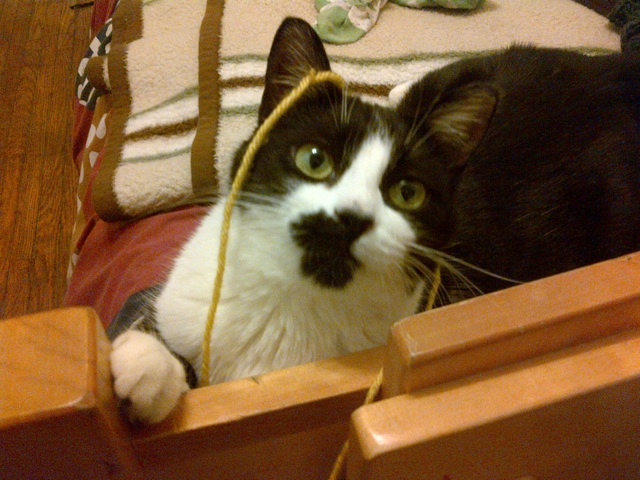
Sock knitting is not quite all-consuming, though, so I’ve been puttering around and doing other things as well. First, I’ve been trying to clean up my stash a little bit. For a relatively new knitting, I have certainly accumulated a lot of wool, and I’m not complaining, but with a yarn-happy cat around, I do need to keep things somewhat orderly.

Ganymede loves to chase knitting.

Ganymede loves to chase knitting.

So, I took an hour or so this week (while watching some silly TV) to wind up some of my ends. I like to knit from the middle out – as opposed to from the outside in – which means that if I don’t entirely finish a cake, it ends up flat and floppy and libel to get very tangled indeed. The solution (for me) is little balls, and now that I’ve gotten the hang of making them even, I quite like them.

From left to right, these are two colourways of Abuelita Mysterious Blend Bulky ( 95% merino-corridale, 5% silk – so soft and gorgeous to knit with), used to knit L a hat, and my leftover Tanis Fiber Arts DK weight 100% Merino. What will I do with this ends? I’m not sure yet, but at least when I get to them they will be easy to knit with.

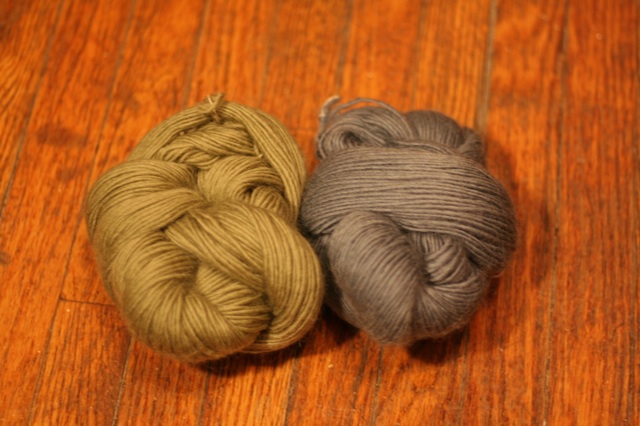
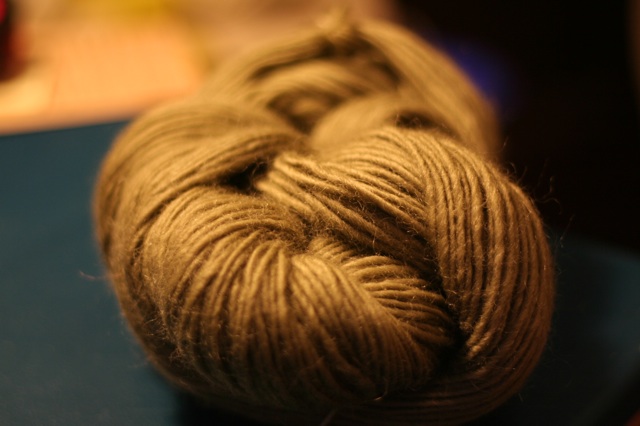
Finally, I realized I have never done anything with the wool I bought in Switzerland in December. I picked it up from a market stall in Bern and, because I don’t speak German and the man selling it didn’t really speak much English or French, all I can say is that it s indeed Swiss wool, but what breed of sheep it comes from and where it was spun remains a mystery.

Swiss skeins

Swiss skeins

One skein is a sort of grey-green and the other is a grey-blue (which you can’t tell in this photo), and they’re both quite wooly and finely spun, which is nice.

The market gentleman was only equipped to sell skeins, which means it still needs to be wound somehow. I’d like to know just how much I have, but ho-hum, I suppose I can add that to its mysterious characteristics. But oh, what to do with them?

Also! I completely forgot, but you remember that nice Maritime wool I bought when I was at home? Well I’ve been swatching it (ostensibly for mittens) and I must say, it is even lovelier to knit with than I first imagined. There’s just enough lanolin to make it soft and almost buttery in your hands, but not so much that it smells or sticks. It also has just the hint of a hallow and although I haven’t quite settled on what I’m going to do with it yet, I am getting very excited to do something with it.

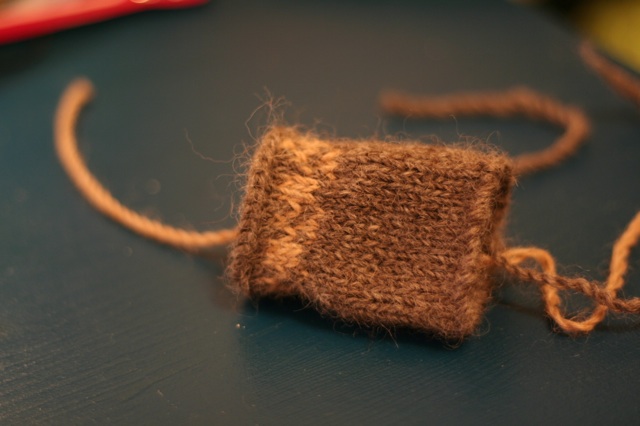
Here’s my swatch (knit on 3.75 mm dpn, which gave me 7 stitches and 9 rows to an inch), including a little section of colourwork, just to see how it went.

Maritime swatch

Maritime Wool

3

Last weekend I escaped the city for the lovely Nova Scotia countryside where I grew up. I hadn’t been home home in over a year, so I was really excited already, but when my mum told me about a local wool producer, I’ll admit that added to my excitement. We went on Friday and then, because I didn’t fully consider my purchases, we went back on Saturday so I could pick up some more wool.

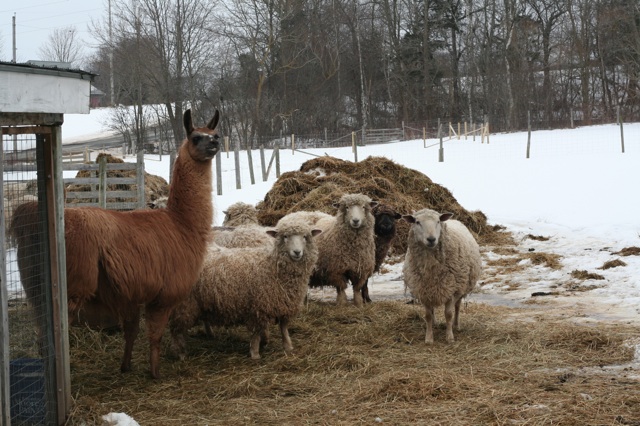
A camera shy Cotswold

A camera shy Cotswold

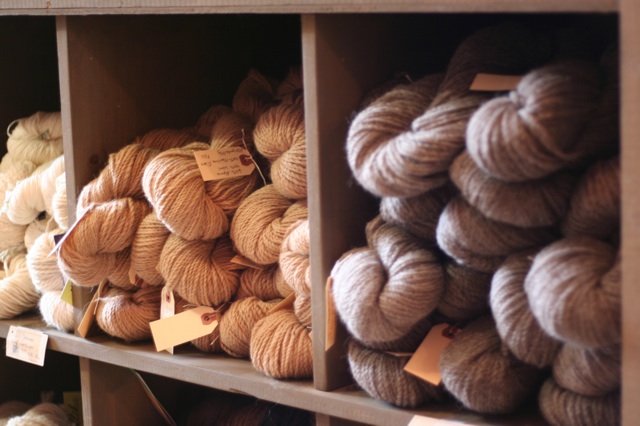
Gaspereau Valley Fibres raises their own Cotswold Sheep, which were once one of the most popular wool sources, but had since been reduced to a rare breed. Cotswold wool is recommended for outerwear, and Gaspereau Valley Fibres offers complimentary patterns with each skein, which come in both natural colours and hand-dyed.

Natural skeins of Cotswold wool.

Natural skeins of Cotswold wool.

The shop is gorgeous – it’s in a converted barn, but has retained all its original post and beam construction, and is headed by a wood stove – and carries a huge selection of fibre. In addition to their own wool, the also carry skeins of 100% Maritime Wool made from 60% New Brunswick alpaca and 40% Nova Scotia Corriedale wool. It is gorgeous and soft enjoyably squooshy and I bought three 250-yard skeins, although I’m not entirely sure what I’m going to do with it yet. It’s also sold in natural colours, which are what I tend to gravitate toward anyhow.

60% alpaca, 40% wool, 100% Maritime

60% alpaca, 40% wool, 100% Maritime

Winding

Winding

All in all it was a great haul from a gorgeous shop. If you find yourself in Nova Scotia, I would definitely recommend stopping by.

A flock of Cotswolds, plus one alpaca, all very curious about what I'm up to.

A flock of Cotswolds, plus one alpaca, all very curious about what I'm up to.

My haul.

My haul.