Clothes for a sheep

13

Amber4

Six weeks ago, two of our best friends had a baby. I already knew I was going to love this kid (her parents are the best — how could she not be!?) but when she held on ten extra days just so she could be born on Chinese New Year, I knew she was a kindred spirit. This is the year of the sheep (or goat), and any baby who wants to be a sheep that badly is clearly going to be showered with knitting. (Also, be warned, there are a lot of photos in this post. Between her inherent cuteness and her dad’s fantastic photos, I couldn’t resist.)

Two days old, already hamming it up.

Two days old, already hamming it up.

We met little Amber the day she came home from the hospital, and as soon as I knew we were going I decided that whip up a little something to bring with us (besides, of course dinner and treats for her parents). I decided to go with a hat, for both speed and immediate practicality. It was friggin’ cold the week she was born (down around -40C with windchill some days), and as most Canadians learn early in life, a hat is indispensable in the winter.

About a week old.

About a week old.

I thought about going with a hat I’ve already made, but where’s the fun in that? I did a quick search through my Ravelry favourites and decided to go with the Garter Ear-Flap Hat from Purl Soho. It’s ridiculously cute with the little ear flaps, and the funny tassel on top was a huge hit. I knit the smallest size, in lighter weight yarn, and it still came out pretty big for a newborn. It will get her through her first winter though, so I consider that a success.

Details
Pattern: Garter Ear-Flap Hat by Purl Soho
Yarn: Tosh Merino DK in Candlewick
Notes: I sped up the decreases to get a (slightly) smaller hat. You can see my notes (such as they are — I knit this quickly and a little on auto-pilot) here.

She loves it.

She loves it. (Also, maybe I should whip her up some tiny mittens?)

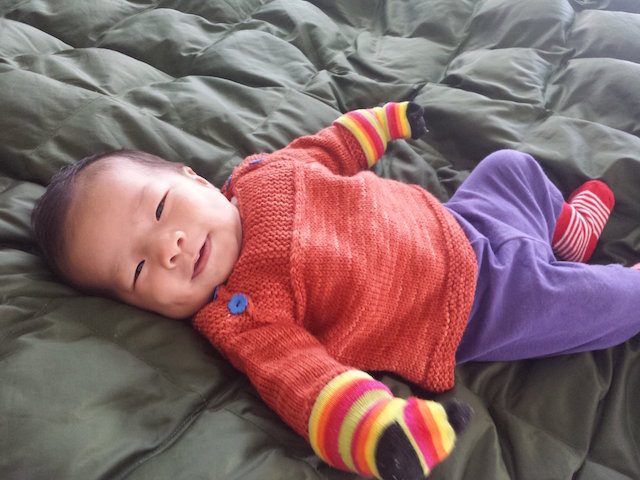
These days Amber is also rocking the Wee Envelop sweater that I knit her months before she was born. I was worried at the time that it might be too small, but it turns out it’s the perfect one-month size, and a big hit.

Amber6

She’s just over a month old here. 

I wrote about this little sweater in the fall when I was knitting it, but I never got proper photos of it before I gifted it, so it didn’t really get its due here. Seriously, though, what a fun knit. I’ve still only knit the one, but it will definitely become a go-to pattern for future babies (and perhaps for Amber, since there’s a generous size range in the pattern).

Amber8

I love a good top-down raglan as much as anyone (and my love of Sunnyside has not yet abated), but it’s fun to knit something a little different, and the construction of this sweater is clever in the best way — that is, it’s fun to knit without being needlessly complicated. I also love that, because you knit the sleeves and yoke first, you can knit the body until you run out of yarn (if you want). That, plus the potential for fun buttons, makes this such a winner for me.

Details
Pattern: Wee Envelop by Ysolda Teague
Yarn: Indigodragonfly Superwash DK in My World is All Askew
Notes: I knit this so long ago I don’t really remember if I changed anything. I knit it at a slightly smaller gauge, so I did make some modifications to accommodate that, but nothing that changed the overall look or construction. Ravelled here.

Amber7

In progress

5

Stockinette is not the most exciting fabric to look at, but it’s all I have to offer at the moment.

epistrophy1

I cast on Epistrophy a couple of weeks ago, and after a bit of a false start (the errata wasn’t linked to the project page, though it is now), it’s been going alone quite nicely. I’m adding 2.5 inches to the length of the body, so it’s just as well I’m enjoying all this knitting. I’m getting quite close to the point where I need to join the sleeves, which of course means I’m getting quite close to the point where I need to actually knit the sleeves. I’m hoping the anticipation of the fun yoke knitting will keep me going through the sleeves so I can get this done before it really is too warm to wear it (it’s snowing right now, so I think there’s a good chance I’ll be able to wear this before the warm weather really arrives).

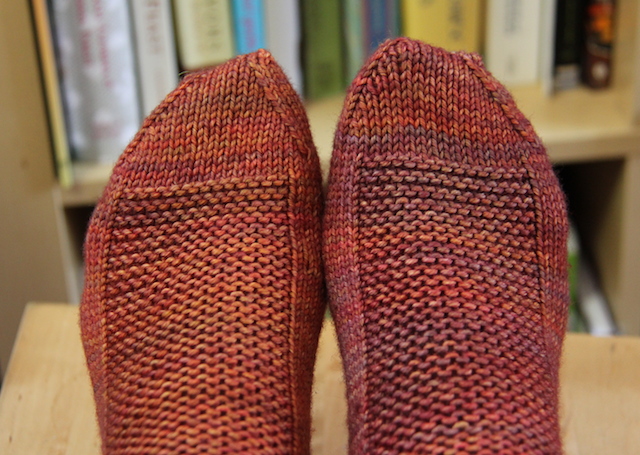
I couldn't resist the contrast heel.

I couldn’t resist the contrast heel.

And of course there are socks. Usually I keep plain stockinette socks as background knitting, as an alternative project for when I’m working on something more involved. At the moment, Epistrophy isn’t all that challenging, so these have languished. They’re quite fun, though, and I suspect that once I decide I need a break from all that treacle-coloured tweed they’ll be quite  palate cleanser.

For sure, though, one of the reasons I’m so content to just sit and knit stockinette for ages on end is that I’ve been sewing. At the moment, it’s the perfect balance of getting the satisfaction of both finishing things and having a longtime project. I’m hoping to get some proper photos in the next few days so I’ll have some actual finished things to show you soon!

An unplanned pair

7

When I wrote that rambly, chatty post about socks, I really didn’t intend to turn it into a series. But then lots of you commented, and I got emails and Ravelry messages, because (of course) I’m not the only ones with thoughts on socks. Lots of you got in touch with notes of sock solidarity, but there were also quite a few questions about how to get started with sock knitting, or about fit or care, so I thought I’d do a little follow-up covering all that stuff. This is, of course, just from my own perspective, so please feel free to chime in in the comments if you have tips/tricks/patterns to add to this sock primer.

Getting Started

One of the best things about being a beginner, in my opinion, is not know what’s supposed to be “advanced.” When every project means learning a new skill, everything is equally advanced, so don’t be afraid to go for socks right away if that’s what you want to knit. I knit my first socks in worsted-weight yarn, which was good for speed (and being able to see the stitches), but I didn’t know all that much about what I was doing, so the fit isn’t the best. Socks were my third knitting project. I knit a scarf, I knit a cowl, and then I knit socks, which just goes to show that you don’t have to be super advanced, just open to trying something new.

steppingstones3

The first pair of Stepping-Stones I made (for my mom), knit in Malabrigo Rios. (These were not my first socks. I still have my first pair, but I don’t have any photos for some reason. )

If you want to just knit a pair of socks to figure out construction, and you live somewhere where a pair of worsted weight socks will be useful at least once in a while, Clara Parkes’ Stepping-Stones pattern (it’s free) is a good place to start. It’s more interesting than plain stockinette, teaches you basic construction, and comes in a couple of sizes. I’m wearing a pair of these socks now, actually, so I can attest to this being a good pattern.

For lighter-weight socks, both Glenna C.’s A Nice Ribbed Sock and Kate Atherley’s Peppermint Twist Sock (stripes optional) are great for beginners. Both of these socks use a flap heel (they’re both knit top-down) and the Nice Ribbed Socks include instructions for a slip-stitch heel (my personal preference), which creates a thicker, more friction-resistant fabric excellent for heels.
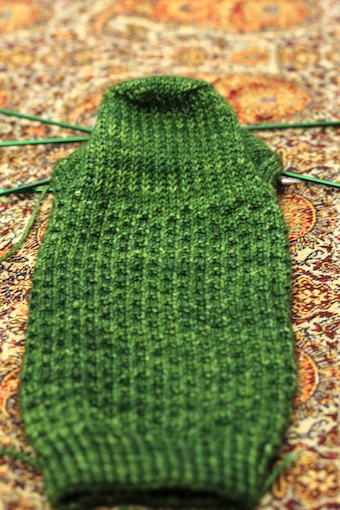
I really dug into the archives for this one! Behold a slip-stitch heel in al its glory.

I really dug into the archives for this one! Behold a slip-stitch heel in al its glory. (The rest of the pattern is Hermione’s Everyday Socks, which is great.)

Sock Literature*

Book-wise, there are a ton of great resources. As far as reference books go, I have both Sock Knitting Master Class and The Knitter’s Book of Socks, and would highly recommend both. Master Class is filled with really excellent information about technique and construction, and includes both toe-up and top-down patterns, with lace, cables and colourwork included among the options. It also has a DVD of some of the techniques, which I found really helpful when I was starting out.

The Knitter’s Book of Socks has lots of patterns as well, but the main thing it will teach you is how to choose the right yarn. There are so many different yarns marketed for socks, and I found the way Clara Parkes breaks down different yarns’ characteristics totally fascinating. It has given me a whole new way to analyze my stash, and it makes me consider yarns differently when I’m in my LYS or planning a new project.

Willowherb, from Coop Knits Socks.

Willowherb, from Coop Knits Socks.

For pure fun, I’m also a huge fan of Rachel Coopey (as you no doubt know) and her book, Coop Knits Socks, is full of great patterns. They’re more advanced, and the instructions are less hand-holding, but if you’ve knit a pair or two of socks, you’ll be fine. Her new book, Coop Knits Socks Vol. 2, actually includes a plain pair of socks (named Dave, because everyone knows a Dave), so it has the base and all the fun.

Operation Sock Drawer

Wherever you start, don’t be afraid to tweak a pattern until it suits you. Personally, I like a tight gauge (9 sts = 1 inch is typical for me), which means I have to knit more stitches on a smaller needle, but that’s okay with me. It also took me ages to figure out exactly how long to knit my foot and then how wide a toe I liked. Each pair is a little experiment, and although I think I have it figured out now, I’ll probably try something a little differently one of these days and then tweak things a little more. That’s what makes it fun.
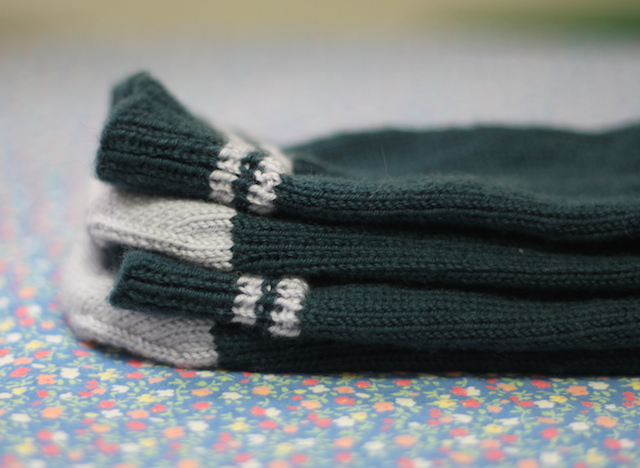
I also tweak the socks I knit for others: These were my dad's Christmas socks, mostly the same as last year's, but with a few subtle changes.

I also tweak the socks I knit for others: These were my dad’s Christmas socks, mostly the same as last year’s, but with a few subtle changes.

Some tweaks are built into a pattern: You can decide for yourself (usually) how much ribbing you want at the top of the leg, how long you want the leg to be, how long you like your heel flap (and how to knit it, or whether to swap it out for a different heel), where to start the toe, etc. One thing I would recommend if you’re new to sock knitting and go the heel-flap route is to more or less ignore the number of stitches the pattern says you have to pick up along the gussets. If you knit a longer heel flap, you’ll need to pick up more stitches (one through each selvedge, and then one or two extras at the top, to ensure you don’t have a hole; if you have a high arch, for example, a longer heel flap and longer gussets are going to make for a better fit). The main thing is to ensure you pick up the same number on each side and then decrease until you’re back to the right number of sole stitches.

I also convert basically every pattern’s decrease directions so that I can use Cat Bordhi’s Slim and Trim SSKs technique (which I just think of as the “hungry stitch method”). It does require both a set-up row (the initial slipping row) and then a closing row (feed the stitch, then knit it), but I love how clean it looks and how easy it is to incorporate into the gussets and toes of my socks.

I love how well the SSKs and K2Togs match, even if the dyelots don't.

I love how well the SSKs and K2Togs match, even if the dyelots don’t.

Wear and Care

As far as washing goes, I sometimes hand wash and I sometimes throw my socks right into the laundry. For hand washing, I just fill up a basin with cool water, add some rinseless wool wash (Soah Wash, Euclan, and Allure are all good ones), and let them soak for a half hour or so (when I add the socks to the water, I squeeze them under the surface, to make sure the water and soap really gets in there, but that’s the extent of the work I put in). After they’ve soaked, I press the water out (squeeze, but don’t twist or wring), roll them up in a towel to get more water out, and then hang them to dry. When I throw them in the laundry, I make sure they’re in a load without towels (or other items that might encourage felting) and make sure the water is cold. Then I hang them to dry. (I don’t do anything fancy when I hang them. Just straighten them out so they aren’t all twisted up and then hang them on a clothes rack or the towel rod.)

Once you start wearing your socks they will, probably, start to wear out. There are lots of great darning tutorials, though I love this one from Twist Collective and have used it to great effect. Some brave people actually cut out the toes or heels and then reknit them and graft them into place, but I have yet to try that (it hasn’t been necessary). Of course, you can always use a worn out pair of socks as an excuse to knit something fun and new, and I would never judge you for it.

Anyway, there you go! What did I miss?

*My friend and I went to the Textile Museum of Canada last week and there was an exhibit of rugs that kept referencing “rug literature,” which I thought was both hilarious and awesome.

Small things

8

It is finally staring to feel like spring is on the horizon, so of course it’s the perfect time to take stock of what’s missing in our winter wardrobes. I do this every year at about this time: what items do we wish we had? What items to we have that need replacing? etc. Usually, though, I do this little inventory and then decide that because everything on the list is small I can do it later — after all, spring is coming and with it lots of fun new projects! — and then inevitably I never get around to the small things.

cowls3

Except, this year I did. At least a little. L and I have been doing a fair bit of cross-country skiing this year (I’m still learning, but he’s been cross-country skiing forever) and it occurred to me recently that neither of us have cowls to wear. In general, neither of us favour neck warmers, but for skiing, and sports in general, they’re just so practical! We do actually have an old black fleece neck warmer of mine, but that doesn’t go far between two people.

honey7

So I made a plan. A couple of years ago, L was given a skein of hand-dyed wool-alpaca yarn by friends of ours (a gift predicated on my knitting him something with it). I think the original idea was for it to socks, but he doesn’t need DK-weight alpaca socks, so the yarn sat in my stash until last week when I realized it was perfect for a neck warmer.

honey8

I started out by knitting him a Honey Cowl (how had I never knit this before?) but realized pretty quickly that it wasn’t thick enough to replace the fleece one. So I doubled it. Basically, I knit it in the Honey Cowl pattern until it was the height of the fleece neck warmer, and then I purled a row (for turning), and switched to stockinette. I went down a needle size and added a strand of alpaca silk laceweight and just knit until the inside was a long as the outside (I had to sub in some other yarn for a wide stripe because there wasn’t quite enough of the main to go the full distance). And the end, after weaving in all the ends I could, I picked up stitches from my cast-on row and closed it all up with a three-needle bind-off. Very tidy, and it made for a very dense and warm cowl, which he seems quite pleased with.

bandit1

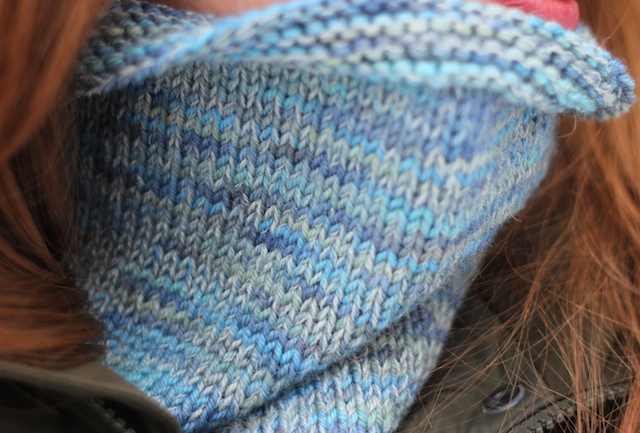
My own cowl needs a little work I think. I knit myself the Bandana Cowl, which seemed practical since that vee of space at the zip of my jacket is a definite cold zone. I used a special single-skein of yarn I’d been holding onto (Tanis Fiber Arts Green Label in Frost, from one of her Etsy updates) and a strand of the same laceweight I’d used in L’s cowl. Because I was using a worsted weight instead of the bulky the pattern calls for, I cast on extra stitches, but I think I maybe cast on a few too many. I’m quite pleased with the proportions of the cowl, but its a little wide at the top. The best solution, I think, is to rip back a few inches in add some extra decreases — maybe three extra sets — so it’s snug enough to stay up over my nose if I need it to.

bandit2

The simple pattern was a perfect use for the yarn, though, and I’m so glad I decided to stop saving it! I’ve been trying really hard to break out of the idea that a yarn is too pretty or special to use.  I don’t have this issue with sock yarns so much, since a single skein is all I need for socks, but I find other weights can be trickier, so I’m on the lookout for good single-skein projects for my pretty yarns.

cowls1

Details
Patterns: Honey Cowl and Bandana Cowl
Yarn: Canadian Alpaca Products and Tanis Fiber Arts Yellow Label in Frost
Notes: Mostly just what I’ve already said above. You can find L’s neck warmer ravelled here, and my cowl ravelled here.

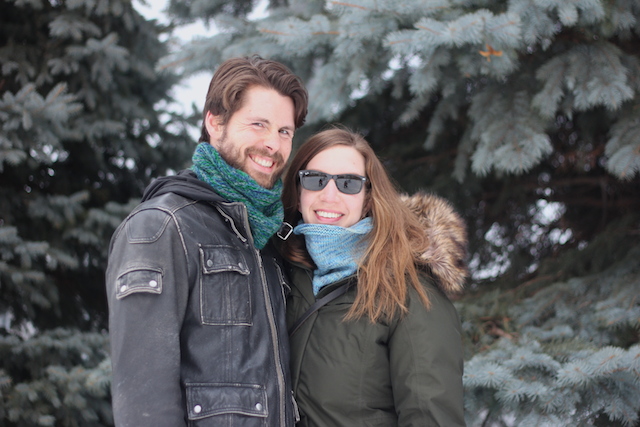
Anyway, it was a lovely day when we took these pictures, and we even got some funny ones of the two of us together (thanks to our very obliging friend Josh, who was visiting). I will leave you with this one, since it’s both my favourite and the most ridiculous.

cowls2b

The lovely Dawlish

13

Oh man, do I love Rachel Coopey’s designs. I know I’ve said it before (probably every time I’ve knit one of her patterns, actually) but it’s true. Her designs are creative, interesting (but not super difficult) to knit, and, best of all, fantastic to wear.

dawlish2

When I bought her first book, Coop Knits Socks, two years ago, Dawlish was one of the patterns I wanted to knit right away. Why it has taken me two years, I don’t know, but I’m so glad I finally got around to it. Actually, speaking of getting around to it, this yarn is one of the first skeins I ever bought without a specific purpose in mind. I remember choosing it, and how expensive and special it felt compared to the other yarn I used up to that point. I have been kind of hoarding it ever since, because even though indie-dyed sock yarns (from this very company, even!) have become a staple of my knitting, there’s something about the early skeins that feels extra-special. Combining it with a long-desired pattern was the perfect match, and I’m happy to say that neither one disappointed.

dawlish4

Dawlish is a quintessential Rachel Coopey pattern. The design across the two socks is mirrored, which means you’re not quite knitting the exact same sock twice in a row. Also, the charts are each a 40-row, 15-stitch repeat, so within the same sock you’re not actually knitting the same repeats over and over again, though there’s enough repetition that it does become intuitive. The pattern is nice and stretch, which isn’t always the case with travelling cables, but there’s lots of ribbing integrated throughout the pattern to ensure a good fit.

dawlish3

Details
Pattern: Dawlish by Rachel Coopey
Yarn: Indigodragonfly Merino Sock in Tiny Bloodsucking Dancer
Needles: 2.5mm
Notes: I swapped out the heel in the pattern for an eye-of-partridge heel. Other than that, I knit exactly as written! Ravelled here.

I have plans to knit both Calamint and Brighton this year, and I am itching to buy her new book as well. Maybe one more pattern from the first book and then I’ll treat myself.

Thoughts on socks

21

Everywhere I look these days (it seems) I run into another article about Marie Kondo and her book/philosophy The Life-Changing Magic of Tidying Up. I’m xnot sure I agree with all of her ideas (though maybe I’m just too intimidated to really try them), but I do love how everyone who writes about her talks about her feelings about socks.

For example, Oliver Burkeman writes in The Guardian: “Kondo thinks you should treat your socks like tiny people, and that when they’re in your sock drawer, they’re “essentially on holiday”.” (The illustration with that story is fantastic.) I also love this bit from Janet Potter’s review in The Millions: “Kondo’s a little hard to pin down. She’s simultaneously a hard-line pragmatist and a far-out child of the moon. For every no-nonsense truth she lays down — “storage experts are hoarders” — she comes out with an impassioned plea to stop balling up your socks — ‘This should be a time for them to rest. Do you really think they get any rest like that?’”

Both of these (and all the other things I’ve read about this book) do actually make me want to change the way I store my socks, if not specifically because I think they (the socks) have feelings, but because I have feelings about my socks. I have favourites. I have different memories and associations attached to different pairs, based on where/when I knit them or where the wool is from. I am genuinely sad when a pair wears out, and I take pains to prolong their lives — whether by knitting them at tight gauge, hand-washing them, or keeping a good rotation so that the wear is spread around. (Or, all of the above, actually.)

Okay, writing that down makes me feel a little strange, but still. If you knit socks you probably understand. And really, that last point is the impetus to keep knitting socks after you already have enough (however you define that). I really like Tanis’s method of keeping some pairs in reserve, but I know myself well enough to know that I don’t have the willpower. I love the feeling of a fresh-off-the-needles pair of socks, and it’s fun to add something new to the rotation, which also helps soften the blow when you realize that formerly favourite pairs are being reached for less and less, as their wear begins to assert itself. (These socks, in particular, were favourites, knit at a time when I had very few pairs of hand-knit socks which meant they were worn constantly, and now have been worn almost to pieces. I really ought to replace them.)

I have actually been thinking a lot about socks in the last little while — ever since Karen asked what knit people couldn’t live without. I’ve been wearing my sweaters like crazy, but the real star(s) of my hand-knit wardrobe are my socks. I have notoriously cold feet (I just tend to run cold everywhere really), but I have noticed a huge difference these last few winters. I’ve always worn wool socks, but there’s a big difference in warmth and quality between the ones I knit myself and the ones I used to buy. For the first time, maybe ever, my feet are reliably warm, and I have no doubt that it’s because the socks I wear now are better quality.

This post was actually supposed to be about Dawlish, which I finished the other night, but it seems to have gotten entirely away from me, so I’ll talk about Dawlish next time. It’s almost funny how much there is to say about something as basic as socks, but then I guess they’re a garment that everyone wears and people often have surprisingly strong feelings about. Where do you stand in the sock camp? Has knitting your own socks changed how you feel about them? (Confession: I used to be a sock hater. So yes, you could say I’ve changed my tune.)

Sweater weather

11

roasty3

Based on the colours alone, I’d say this yarn was inspired by fall. But honestly, for me true sweater weather doesn’t fully assert itself until mid-winter — by late January, the worsted weight sweaters that earlier seemed more like jackets than cardigans are in regular rotation and another lighter needs at least one heavy-ish layer underneath it. (The temperature went up to -4 last week, and I got all excited and wore just a T-shirt under my Grace cardigan. When I got to work, I realized my  mistake and ended up wearing my emergency wool sweater over top. Turns out sweater weather is as much an indoor thing as outdoor).

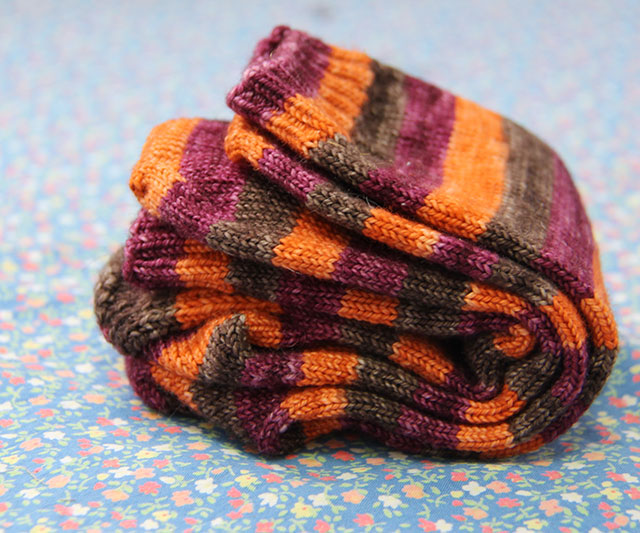
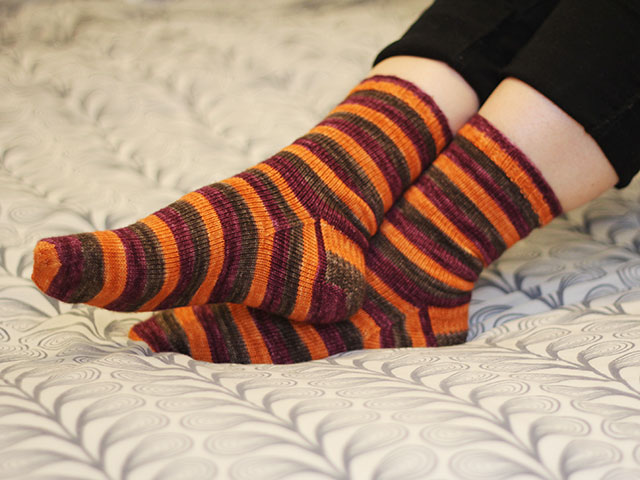
Anyway. I can happily say that despite the very, very cold weather, my feet have been nice and warm thanks to my supply of wool socks. Given my feelings about sweater weather, then, it should come as no surprise that I decided to ignore the seasonal colours and knit these up in the dead of winter.

roasty7

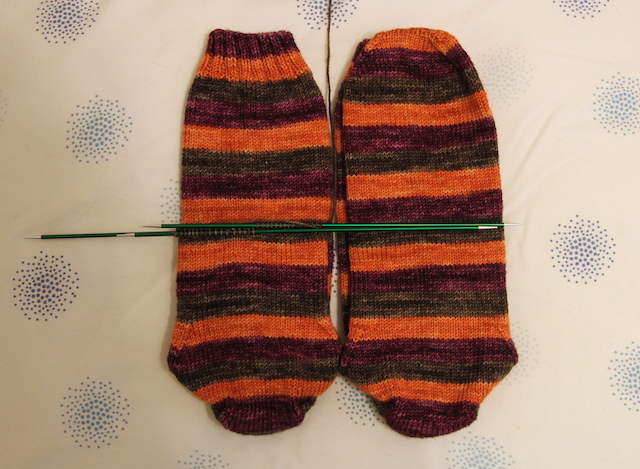
Although these were on my needles for a while, don’t read that as a lack of enthusiasm on my part. (I actually finished these a while ago and, really, I was just enthusiastic about an actual sweater.) When these were my actual focus, the knitting flew. I find that to often be the case with striped socks, but still. I actually added a bit of length to the legs of these socks, both because I wanted to minimize my leftovers and because it’s really cold out and a little extra protection from the draught is a good thing.

roasty6

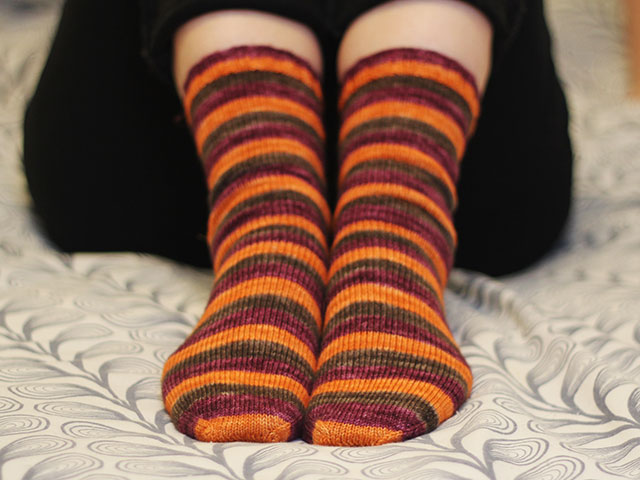
These are just my basic 68-stitch, top-down, tight-gauge (9 sts = 1 inch) socks, with 2×2 ribbing at the top and a slip-stitch heel. It’s a formula I use a lot, but in the last six months or so I’ve nailed down the fit of the foot to pretty much perfection, resulting in socks that fit so well I forget I’m wearing them (even at the end of a long day of walking there’s no sagging or movement).

roasty4

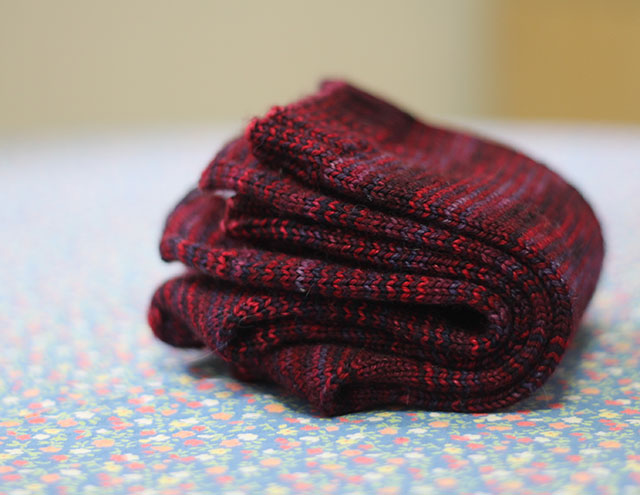
What really makes these socks worth such a (now) lengthy post, though, is the yarn, Nomadic Yarns Twisty Sock. These stripes are so evenly dyed, with such nice blending between the colours, that with not a lot of effort on my part I ended up with a perfectly matched pair. I have another decidedly Christmasy skein of this yarn in my stash, but now that these are off the needles and seem to be wearing well, I think ordering a few more is a good investment. Goodness knows that, with winters like this starting to feel like the norm, more socks won’t go to waste.
Super-cozy Bedford

25
Thrilled. To. Pieces.

Thrilled. To. Pieces.

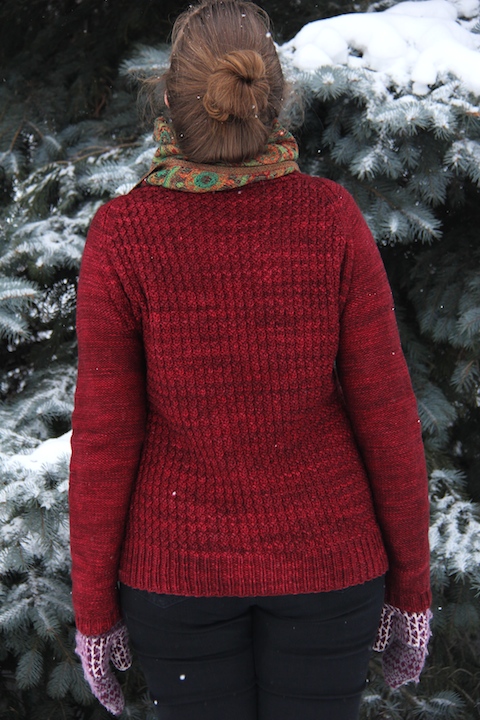
At last! I feel like it took almost as long to get photos of this sweater as it did to knit it! That’s an exaggeration, but the knitting really did feel like it was flying. Plus, I didn’t want to wear it until we’d taken photos (just in case), so Bedford sat finished and folded for a week before I finally got to wear it (and yes, I’ve been wearing it a fair bit since then).

Bedford9

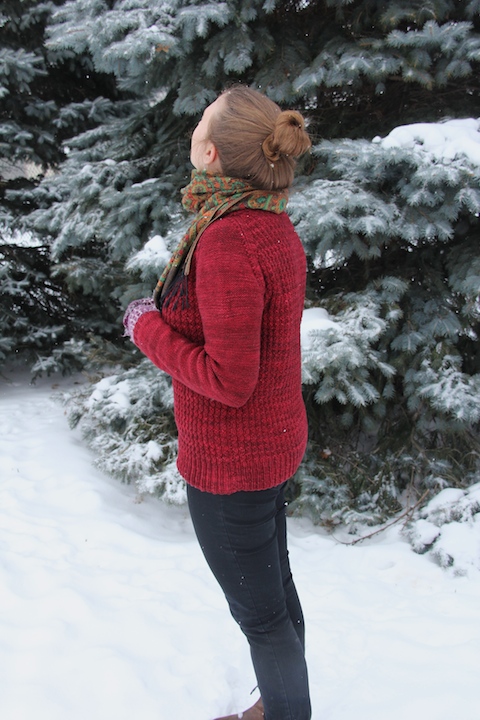
This is the big, cozy sweater of my mid-winter dreams. I knit this with the intent to have something slightly oversized (for layering) and that is exactly what I got (I was aiming for 3-4 inches of positive ease and got 6, which I’m okay with). It is perhaps not the most figure flattering sweater, but the stretchy texture of the all-over stitch pattern means that it isn’t shapeless or too tent/sack-like, which is what holds me back from knitting other oversized sweaters like Benton and Boxy, which I admire from afar. Bedford, for me, fits that perfect middle-ground usually reserved for a favourite sweatshirt: oversized without looking too big, with the bonus of being a sweater I can happily wear out of the house.

Bedford11

Speaking of which, when we shot these photos it was -4C (about 25F) and snowing, and I wasn’t really cold. Obviously I left my scarf and mittens (these ones) on, but otherwise I was okay. I expected to be shivering and asking L to hurry up, but Bedford is surprisingly warm! It is a worsted-weight sweater, but I’d say it’s warmer than my Woodstove Season cardigan, which is knit at a similar gauge and in a similar wool. All that texture really pays off warmth-wise without making it way too hot to wear indoors (so far I’ve worn Bedford around my apartment, out to a restaurant, to an art gallery, and to work, and nowhere have I been uncomfortably warm).

Bedford8

Construction-wise, I pretty much followed the pattern exactly. Knitting the sleeves inside out (which is to say, in stockinette rather than in reverse stockinette) worked out just fine — I just turned them right side out when it was time to join them to the body and there were no issues. I actually really like the look of the reverse-stockinette sleeves, so I might try this again on another sweater, just for fun. I also added fake-seams along the raglan lines. In the pattern, there are two stockinette stitches along the raglan lines, so I added a purl stitch in there (k1, p1, k1), which I then closed up exactly the way Karen describes in her tutorial. This is a heavy sweater, so I’m glad to have a bit of reinforcement along the lines where a lot of the weight hangs.

I had to change a few things in the raglan shaping/neckline to get the decreases to line up with my row gauge. I don’t remember exactly what I did, but I do know that I worked the raglans for 6 inches before binding off the initial neckline stitches (if I’d stuck to the pattern, this would have had quite a scoop neck). I also tried a new method for binding off the neckline stitches and I’m really happy with the result (my scarf kind of covers it up, but you can see the neckline in the photo in this post). It made for a very smooth bind-off, which in turn made it very easy to pick up the stitches for the ribbing. I will absolutely use this method going forward.

Bedford10

Details
Pattern: Bedford by Michelle Wang
Yarn: Madelinetosh Vintage in Tart (from my stash! Woo!)
Notes: Besides what I’ve already mentioned, I added a few inches to both the body and sleeves. I also knit the sleeve ribbing on a smaller needle, in an attempt to avoid baggy cuffs. I didn’t totally succeed, but it turns out that reverse-stockinette is the perfect folding fabric. That is, usually I just push up my sleeves, but it turns out that if I fold these back the purl bumps grip each other quite nicely, so fitted cuffs aren’t such an issue. If I were knit this again (you never know), I would knit the bottom ribbing on a smaller needle too, just to give it a little more structure. Anyway, you see notes and whatnot on Ravelry, here.

I am itching to cast on another sweater, but haven’t yet found the perfect yarn for Epistrophy (I have some swatching to do), so I’ve decided to stick to small projects for the rest of February. I’m trucking along on my Dawlish socks, and I wound some yarn for new mittens, and I could use a new cowl. Basically, before I commit myself to another big project, want to get a revel in finishing some things first. That’s a kind of balance, right?

Baubles

9

Remember when I said I wanted to make a bunch of Christmas tree decorations this year, well in advance of actually needing them? Well, I got my act together and I’m doing it! I knit the first one after finishing Bedford, and let me tell you that it is deeply satisfying to finish a small a pretty thing in one sitting after a finishing something that took a month (something that is still awaiting photos — they’re coming, I promise!).

bauble1

I used the basic Balls Up! template and the subbed in the chart of tincanknits’ Clayoquot cardigan. The yarn is all leftovers except the white, which is a Tosh Unicorn Tail purchased for this very project (at only 30g, I’m hoping I won’t have any leftovers, though this ornament didn’t use up much). I’m looking forward to playing with different colours and patterns, and using up some of my many, many leftovers. I don’t save everything, but often I finish a pair of socks and there’s 10g or so of the yarn left over, which seems like too much to throw away (and what if I need it for darning!?), so this will be a good way to work through some of that.

I don’t plan to blog every one of these, but I’m going to keep them all as one project on Ravelry, so you can keep up with them here, if you’re so inclined. This one was so quick (just an hour and a half, including fiddling with the chart), so I suspect they’ll become my go-to palate cleanser between biggish projects. Are you intrigued enough to make some along with me?

Buckled down

7

Three days ago, I finished Bedford. Less than one month after casting on (though, thanks to a stupid error on my part that required me to rip out three inches, I missed finishing in January. Oh well). I don’t remember the last time I happily worked on a project with that kind of single-minded attention. No deadlines, no pressure, just happy knitting and the knowledge that, at the end, I’d have a cozy sweater. The cold, I suppose, is a powerful motivator. Anyway, it’s done, and I’m not going to say any more about it right now, since I’m still waiting for the chance to get proper photos, at which point it will get its own post.


bedford6

Okay, not quite true. I will also say this: I think one of the things I liked best about knitting Bedford was that I never felt guilty when I knit on something else. Guilt isn’t a feeling I tend to associate with my knitting, but sometimes when I’m beavering away* on a big project, I feel like it’s all I should be working on, which makes choosing to knit a few rounds on a pair of socks seem like a cop-out. I don’t know why that happens — unrealistic deadline setting, maybe? For Bedford I just wanted it done sometime in January/February, which turned out to be perfect — but it does, can sometimes deter me from casting on a big project (maybe I’m past that now!).

Almost an exact match so far!

Almost an exact match so far!

Anyway, I did sneak in a few rows (and afternoons) with my fun striped socks-of-the-moment, which means they’re pretty close to finished too! Just a few more inches and they’ll be off the needles and on my feet! I can’t wait, to be honest, the colours are fun and there’s just nothing like a fresh pair of socks. I’m particularly thrilled with this yarn (Nomadic Yarns) and am considering ordering a couple more balls (Mantel and Poolside, I’m looking at you…) — once I’ve knit through a little more of my stash, of course.

*This is a hilarious Canadian expression that basically means putting your head down and work hard at a specific task.